


The famine that killed hundreds of thousands, and changed North Korean society forever.
Imagine waking up tomorrow and discovering that the supermarket is empty. Not because of a temporary shortage, a delivery problem, or a national holiday, but because the entire system responsible for providing your food has stopped working.
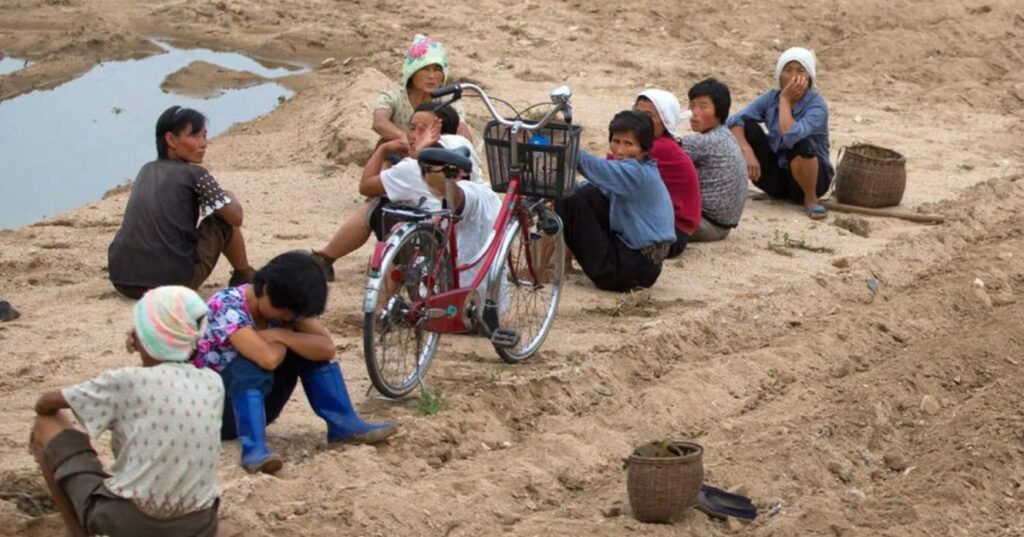
You still have a job. You still have a home. The government still tells you that everything is under control. But there is nothing to eat. For millions of North Koreans, this became reality during the 1990s. What followed was one of the deadliest famines of the late twentieth century. Hundreds of thousands of people died, families were separated, and ordinary citizens were forced to make impossible choices to survive.
In North Korea, this period became known as the Arduous March (Gonan-ui Haenggun), a name associated with the country’s revolutionary history and the hardships endured by Kim Il Sung’s guerrilla fighters. But behind this heroic-sounding name was a very different reality: a country where people were starving, while the political system that had promised to take care of them struggled to keep itself alive.
And perhaps the most surprising part of this story is what happened next.
A Country That Promised to Provide Everything
To understand the famine, we first need to understand how North Koreans obtained their food.
Unlike in most countries, where people buy groceries using their income, much of North Korea’s urban population depended on a government-run Public Distribution System (PDS). The idea was relatively simple. Citizens worked in state-assigned jobs, and in return, the government distributed food rations and other basic necessities. How much someone received depended on factors such as their age and occupation.
For many families, receiving food was therefore closely connected to their relationship with the state.
This system also served a political purpose. When the government controls access to essential goods, people’s everyday lives become closely tied to the institutions governing them.For decades, North Korea managed to maintain this system partly through economic support and trade with the Soviet Union and China.
But that dependence would soon become a major weakness.
When Everything Began to Fall Apart
The famine did not begin with a single bad harvest.
Its roots went much deeper.
When the Soviet Union collapsed in 1991, North Korea lost an important trading partner and source of subsidised fuel and other supplies. Factories struggled to operate, agricultural machinery became harder to run, and the production of fertilisers suffered. This was particularly damaging because North Korean agriculture depended heavily on industrial inputs, including fuel, machinery, and chemical fertilisers.
At the same time, the country’s centrally planned economy had already been struggling with inefficiency and poor agricultural management.
Then came the natural disasters.
Severe floods in 1995 and 1996 damaged farmland, infrastructure, and food supplies. Drought and poor harvests added further pressure. But here is an important distinction: the famine was not simply a natural disaster.
Flooding can destroy crops. Economic problems can reduce food supplies. But whether these events become a nationwide famine also depends on how governments respond, distribute resources, and allow people to find alternatives.
In North Korea, the food distribution system was already breaking down, while restrictions on trade and movement made it difficult for people to respond independently. By the mid-1990s, many families were no longer receiving enough food through official channels.
For some, the rations stopped altogether.
When Hunger Became Everyday Life
It is difficult to know exactly how many people died during the Arduous March.
North Korea’s secrecy and the lack of reliable demographic information make precise estimates impossible. Some scholarly estimates suggest that between 600,000 and one million people died, although estimates vary considerably.
But statistics can make suffering feel strangely distant.Six hundred thousand people is an enormous number. Yet it tells us little about what hunger meant for an individual family. In a 2006 Human Rights Watch report, a North Korean woman identified as Ms. Kim described what she had witnessed during the famine. She escaped North Korea in 2005, but had stopped receiving government food rations back in 1996.
She recalled knowing approximately fifteen people who had died from hunger. One acquaintance had lost her entire family. Dead bodies had become a familiar sight at train stations and on the streets.
For Ms. Kim, 1997 was the worst year. Her own family managed to avoid the worst of the hunger partly because she worked for a trading company that exchanged goods with Chinese merchants. Her mother also earned money selling fabric, buttons, and zippers at a market. Looking back, Ms. Kim explained that conditions eventually improved because people began selling goods at markets.
“That’s how we all survived.”
Her experience reveals something important about the famine. Survival was not simply about how much food existed in the country. It was also about whether people could access it. Those who had something to trade, connections to merchants, or opportunities to earn money sometimes had better chances of finding food. Others were left waiting for government rations that might never arrive.
For many families, survival meant selling their belongings, searching for wild plants, travelling in search of food, or crossing the border into China. And while the government continued to claim responsibility for providing basic necessities, ordinary North Koreans were increasingly discovering that they could no longer depend on it.
The famine was not only changing how people survived. It was changing how they lived.
And that change would have consequences long after the worst years of hunger had passed.
The Unexpected Rise of the North Korean Entrepreneur
Here is where the story takes an unexpected turn.
North Korea was built around a centrally planned economy, where the state was supposed to control production and distribution. Private trade was heavily restricted. Yet when the state could no longer provide food, people increasingly began doing something they were not supposed to do.
They started trading.Small informal markets expanded as people sold vegetables, household belongings, food, and goods brought across the Chinese border.
These markets eventually became known as jangmadang.
And although market activity had existed before the famine, the economic collapse dramatically increased its importance. For many families, selling something at a market became more useful than waiting for food rations that might never arrive.
This also created an interesting shift in family roles. Men were often still expected to report to their state-assigned workplaces, even when those workplaces could no longer provide meaningful wages or food. Married women, who were generally subject to different employment obligations, often had greater opportunities to participate in informal trade. As a result, many women became the main earners in their households.
Think about the contradiction for a moment.
In a country where the government tried to control economic activity, ordinary citizens were increasingly keeping themselves alive through private business. And in a society built around a strongly patriarchal political system, women were becoming essential economic providers.
The famine did not create economic freedom in North Korea. Trading remained risky, and markets were subject to government restrictions. But it did change the relationship between ordinary people and the state. For many North Koreans, survival was no longer something the government could guarantee.
It was something they had to organise themselves.
When Survival Became a Political Question
This raises an uncomfortable question.
If a government claims responsibility for providing food, what happens when it fails?
The Arduous March was not only a humanitarian disaster. It was also a crisis of political responsibility. North Korea’s leadership continued to prioritise the survival of its political system, while restrictions on movement, information, and economic activity limited the ways ordinary people could respond to hunger. In 1995, North Korea made an unusual appeal for international food assistance. International organisations, including the World Food Programme, subsequently provided substantial humanitarian support.
However, delivering aid was complicated by restrictions on access and monitoring. Humanitarian organisations could not always independently verify whether assistance reached the people who needed it most. This created a difficult dilemma: how could international organisations help starving civilians without giving the government unrestricted control over the assistance?
Meanwhile, the expansion of informal markets showed that people were finding their own ways to survive.
This does not mean the famine was somehow beneficial. The human cost was devastating, and many survivors experienced lasting physical and psychological consequences. But it does reveal something important about the limits of political control.
A government can restrict economic freedom, but it cannot eliminate people’s need to survive.
When the official system failed, ordinary North Koreans increasingly developed alternatives, even when doing so meant breaking the rules.
The Generation That Grew Up During the Famine
The consequences of the Arduous March did not disappear when the worst years of starvation ended.
Children who grew up during the famine experienced a very different North Korea from their parents. Older generations had lived through periods when the state distribution system played a central role in everyday life.
For younger people, however, markets increasingly became a normal part of obtaining food and other necessities. The jangmadang continued to develop after the famine, and the government eventually tolerated or formally permitted certain forms of market activity while continuing to regulate and restrict them.
These markets also helped goods, money, and sometimes outside information circulate through North Korean society.
The result was a complicated relationship.
The state continued to claim authority over the economy, while many households relied on market activities to meet their everyday needs. North Korea had not become a free-market economy. Nor had its political system collapsed. Instead, the country had changed in ways that were difficult to reverse completely.
More Than a Story About Hunger
When we discuss North Korea today, the conversation often focuses on nuclear weapons, missile tests, and the Kim family.
But the Arduous March reminds us that some of the country’s most important transformations happened far away from military parades and political speeches.
They happened in homes where parents tried to find enough food for their children.
At train stations where people searched for opportunities elsewhere.
And in small markets where ordinary citizens began selling whatever they could.
The famine exposed the devastating consequences of a system in which people’s access to food depended so heavily on the state. Yet it also revealed the resourcefulness of people who had been given very few alternatives. Perhaps that is the most important legacy of the Arduous March.
The North Korean government survived the famine. But the society it governed would never be quite the same.
And the markets that grew out of this period of desperation would go on to shape everyday life in North Korea for decades.
You would like to support us ? Consider making a donation to help us keep this work going !