


5 Things to Know – 2026/10/11
For nearly eight decades, North Korea has been ruled by one family. Now, the emergence of a possible fourth-generation successor raises questions about the future of the world’s most prominent hereditary socialist leadership.
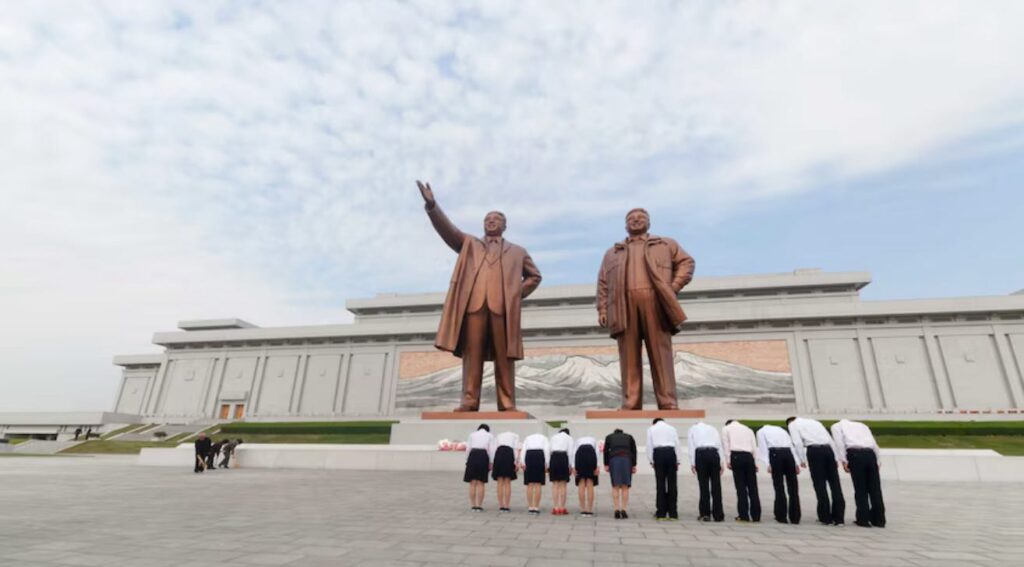
For almost eight decades, one family has stood at the centre of North Korea’s political system. Three generations, three leaders, and a country that has undergone enormous changes while remaining under the control of the same bloodline.
Since the establishment of the Democratic People’s Republic of Korea (DPRK) in 1948, power has passed from Kim Il Sung to his son Kim Jong Il, and eventually to his grandson Kim Jong Un. Although North Korea is officially a socialist republic, its leadership operates much like a hereditary dynasty. Rather than relying on royal titles, the Kim family’s authority is reinforced through political institutions, revolutionary ideology, an extensive personality cult, and the concept of the Paektu bloodline, which presents the family as uniquely entitled to lead the nation.
Now, with Kim Jong Un’s young daughter appearing increasingly frequently at important state events, a new question is emerging: is North Korea preparing for a fourth generation of Kim rule?
Kim Il Sung: The Founder of a Dynasty
(1948–1994)
The foundations of the Kim dynasty were laid in the aftermath of the Second World War.
Following the end of Japanese colonial rule in 1945, the Korean Peninsula was divided into Soviet and American occupation zones. In the Soviet-backed North, Kim Il Sung emerged as the dominant political figure, becoming the country’s founding leader in 1948. Two years later, North Korea invaded South Korea, triggering the Korean War. Although fighting ended with an armistice in 1953, the two Koreas never signed a peace treaty.
Over the following decades, Kim Il Sung transformed North Korea into a highly centralized state built around his personal authority. State propaganda portrayed him as the revolutionary father of the nation, while Juche, an ideology emphasizing national independence and self-reliance, became a defining feature of North Korean political identity.
But loyalty to the leadership extended far beyond politics. Under Kim Il Sung, North Korea developed songbun, a social classification system that categorized citizens according to their perceived political loyalty and family background. These classifications influenced access toeducation, employment, housing and other opportunities, making political status an important factor in everyday life.
By the time Kim Il Sung died in 1994, his legacy extended far beyond his nearly half-century in power. He had established a system in which loyalty to the state and loyalty to the Kim family had become deeply intertwined.
And unlike most socialist leaders, he had prepared his own son to take his place.
Kim Jong Il: A Dynasty Tested by Crisis
(1994–2011)
When Kim Jong Il succeeded his father in 1994, North Korea entered a new chapter. What had officially been established as a socialist republic had now undergone its first hereditary transfer of supreme leadership.
His rule began during one of the country’s most devastating periods. Following the collapse of the Soviet Union and the loss of crucial economic support, North Korea experienced a severe economic crisis and widespread famine during the 1990s. Hundreds of thousands of people are estimated to have died, although the exact death toll remains disputed.
As ordinary citizens struggled to survive, Kim Jong Il placed increasing emphasis on the armed forces through Songun, commonly known as the military-first policy. Military institutions gained political prominence, while the country’s nuclear programme became an increasingly important element of its national security strategy.
Yet the crisis also transformed North Korean society in ways the government had not fully anticipated. As the state-run food distribution system collapsed in many areas, citizens increasingly turned to informal markets to obtain food and basic necessities. These markets gradually became an essential part of everyday economic life, creating new forms of trade outside the traditional state distribution system.
Despite the economic hardship and social changes, the political leadership remained within the family.
When Kim Jong Il died in December 2011, power passed to his youngest son, Kim Jong Un, marking the beginning of a third generation.
Kim Jong Un: Modernization Under Tight Control
(2011–Present)
When Kim Jong Un assumed power in 2011, he was still in his twenties. Unlike his father and grandfather, he inherited a country where informal markets had become established and new technologies were beginning to reshape everyday life.
Under his leadership, parts of North Korea have undergone visible modernization. New residential districts, shopping facilities and leisure complexes have appeared in Pyongyang, while mobile phones and domestic digital services have become increasingly accessible to certain segments of the population.
However, economic and technological modernization has not been accompanied by comparable political freedoms.
While digital technology has created new possibilities, it has also provided the government with additional methods of monitoring information and communication. Access to the global internet remains highly restricted, and the distribution or consumption of unauthorized foreign media, particularly South Korean entertainment, can result in severe punishment.
A 2025 United Nations human-rights report documented continuing restrictions on freedom of expression, movement and access to information, alongside forced labour, arbitrary detention and other serious violations. The report also highlighted the government’s continued prioritization of military and nuclear development.
North Korea under Kim Jong Un therefore presents a striking contrast: a country experiencing selective modernization while maintaining extensive political and social controls.
After more than a decade in power, however, attention is beginning to shift beyond Kim Jong Un himself.
Kim Ju Ae: A Fourth Generation in the Making?
In November 2022, a young girl appeared alongside Kim Jong Un at a ballistic missile launch. She was later identified by South Korean intelligence as his daughter, Kim Ju Ae. What initially appeared to be an unusual family appearance has since developed into a subject of international speculation.
Believed to be in her early teens, Kim Ju Ae has become an increasingly visible presence at military ceremonies, weapons demonstrations and other important state events. In a country where public appearances, seating arrangements and proximity to the supreme leader carry considerable political symbolism, her growing prominence has attracted close attention.
In April 2026, South Korea’s National Intelligence Service assessed that she appeared to have been positioned as her father’s successor. However, North Korea has made no formal announcement confirming such plans, leaving considerable uncertainty about her future.
One potential obstacle is North Korea’s traditionally patriarchal political system. All three supreme leaders have been men, and senior military and political positions have historically been male-dominated. Nevertheless, the increasing visibility of influential women within the leadership, particularly Kim Jong Un’s sister Kim Yo Jong, may be helping normalize female authority within the ruling family. This does not necessarily indicate broader progress in women’s rights, but it could influence perceptions of a future female leader.
Other possible successors include Kim Yo Jong herself or Kim Jong Un’s rumoured older son, whose existence has never been independently confirmed.For now, Kim Ju Ae’s role remains open to interpretation. Her appearances could signal preparations for succession, strengthen the public image of the Kim family, or serve several political purposes at once.
Still, the possibility of a fourth generation raises an important question: could preserving the Kim bloodline ultimately take precedence over North Korea’s traditional expectations of male leadership?
The Future of the Dynasty
The story of the Kim dynasty is not simply about three leaders who inherited power. It is also about the political institutions and social structures that have developed around their rule.
Over nearly eight decades, the North Korean government has maintained a system in which political loyalty, access to information and social opportunities are closely connected to the state. International human-rights investigations have documented widespread surveillance, restrictions on movement and expression, political imprisonment and discrimination. North Korea, meanwhile, rejects many of these findings and maintains that its political system protects the interests and rights of its citizens.
For organizations such as PSCORE, understanding the Kim dynasty is therefore essential to understanding the human-rights challenges facing North Koreans today. The restrictions experienced by citizens are not isolated policies, but part of a political system that has developed and adapted across generations.
Kim Il Sung established its foundations. Kim Jong Il maintained the system through a devastating national crisis. Kim Jong Un has adapted it to an increasingly digital world.
Whether Kim Ju Ae will eventually inherit that legacy remains uncertain. But after almost eighty years of uninterrupted family rule, the possibility of another hereditary succession suggests that the Kim dynasty may be preparing to extend its influence well into the future.
The question is no longer simply who will lead North Korea next, but what another generation of Kim rule could mean for the people living under it.
You would like to support us ? Consider making a donation to help us keep this work going !