


5 Things to Know
North Korea has spent decades telling its people that they need nobody else. But what happens when the government itself stops being someone they can rely on?
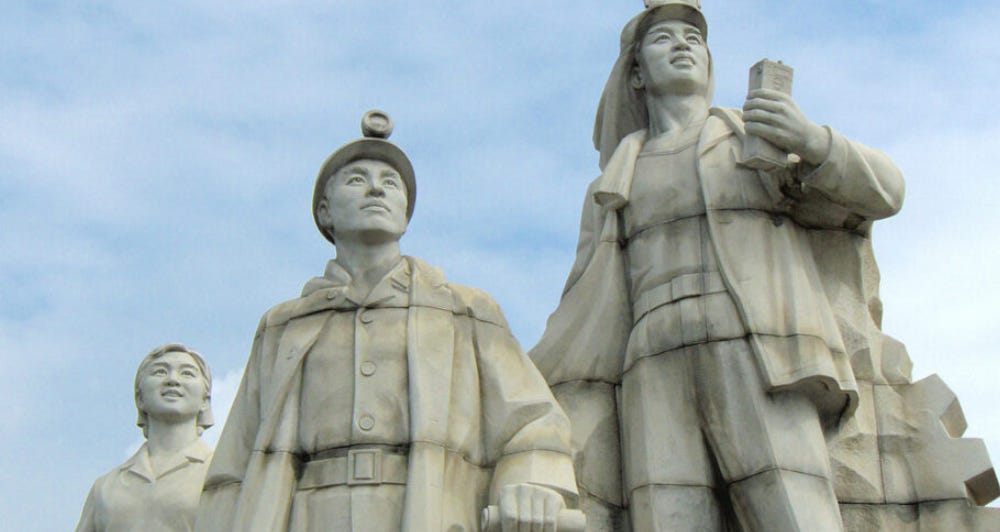
Imagine living in a country where independence is more than a political ambition. It is a national identity, a philosophy taught in schools, and a principle that shapes almost every aspect of daily life. Your country tells you that relying on outsiders is dangerous, that true strength comes from standing on your own two feet, and that your nation has everything it needs to succeed.
Sounds empowering right?
Now imagine that same country struggles to feed its population, restricts access to foreign goods, and punishes people for economic activities that might help them survive. Welcome to the contradiction at the heart of North Korea’s Juche ideology.
For decades, North Korea has promoted self-reliance as the foundation of its political system. Yet behind the grand speeches, enormous monuments, and patriotic slogans lies a rather different story. One in which ordinary people have become remarkably resourceful, not necessarily because the system encourages independence, but because they have had little choice.
The Philosophy of Doing It Yourself
To understand Juche, we need to travel back to 1955.
The Korean War had ended just two years earlier, leaving the peninsula devastated and divided. North Korea was rebuilding, with significant assistance from its communist allies, the Soviet Union and China. But Kim Il Sung, North Korea’s founding leader, had an ambition beyond reconstruction. He wanted a country that could determine its own future without simply following Moscow or Beijing.
In a speech delivered in December 1955, Kim introduced the concept of Juche, a Korean term often associated with being the subject or master of one’s own destiny. Over time, this developed into a broader political philosophy emphasizing independence in politics, self-sufficiency in the economy and self-defence in military affairs.In theory, the message was appealing: North Korea should make its own decisions, develop its own economy, and defend itself without spending on its foreign powers.
And considering Korea’s history of Japanese colonial rule, foreign occupation, and war, the desire for national independence was hardly surprising.
However, Juche gradually became much more than a strategy for national development. Under Kim Il Sung and later Kim Jong Il, it developed into a comprehensive state ideology that also helped legitimize the leadership of the Kim family. The message was no longer simply that North Korea should determine its own future. It was increasingly that the country’s future depended on following its leaders.
There was also one rather inconvenient detail.
North Korea was never particularly good at being completely self-reliant.
Self-Reliance, With a Little Help From Your Friends
Despite its commitment to economic independence, North Korea relied heavily on assistance and trade from the Soviet Union and China.
The Soviet Union supplied fuel, machinery, technology, and other essential resources. China provided economic support and became an increasingly important trading partner. For a country committed to standing on its own, North Korea certainly benefited from having powerful friends. For several decades, this arrangement helped sustain the economy. However, when the Soviet Union collapsed in 1991, North Korea lost a major source of economic support and preferential trade.
The consequences were devastating.
Combined with structural economic problems, agricultural failures, and natural disasters, the loss of Soviet support contributed to the catastrophic famine of the 1990s, known officially in North Korea as the Arduous March. Hundreds of thousands of people are estimated to have died, although the exact number remains disputed.
The state-run food distribution system, on which much of the population depended, could no longer reliably provide basic necessities. And this is where the story of self-reliance takes an unexpected turn. While the government continued to promote Juche, ordinary North Koreans began practising a very different version of it. Not to defend national sovereignty or fulfil a revolutionary ambition.
Simply to survive.
The Accidental Entrepreneurs of North Korea
Picture a North Korean woman in the late 1990s.
Her husband works at a state-assigned job, but his wages are insufficient to support the family. The food distribution system is no longer providing enough to eat. She has children to feed, and waiting for the government to solve the problem is no longer an option.
So she starts trading.
Perhaps she sells vegetables grown in a small garden, homemade food, or goods obtained through informal trading networks. She exchanges what she has for something her family needs. Across North Korea, countless people began doing something similar. These activities contributed to the growth of the jangmadang, informal markets that eventually became an essential part of everyday economic life.
Ironically, the markets emerged partly because the centrally planned system could not meet people’s needs. Women became particularly important in this new economy. While many men remained tied to state-assigned employment, married women often had greater opportunities to participate in trading activities.
For some families, the money earned through these markets became their primary source of survival. The markets also introduced something that North Korea’s tightly controlled economy had long tried to limit: a degree of individual economic decision-making. People could negotiate prices, respond to demand, and build trading relationships. Some gained financial independence and opportunities that had previously been almost unimaginable.
Yet this independence came with risks.
Private trading existed within an uncertain and frequently changing legal environment. Traders could face confiscation, demands for bribes, or punishment for violating regulations. The state that celebrated self-reliance was not always comfortable with citizens becoming self-reliant on their own terms. And that raises an interesting question:
If ordinary North Koreans are capable of providing for themselves, why does the government need to control how they do it?
When Independence Becomes a Human Rights Issue
At first glance, Juche might seem like a political or economic concept rather than a human rights issue.
But its consequences reach far beyond government policy. Consider the right to food. A government can promote national self-sufficiency as a legitimate development objective. However, when restrictions on trade, markets, and economic activity prevent people from accessing food, the pursuit of that objective can come into conflict with fundamental human rights.
According to the United Nations, more than 45% of North Korea’s population, approximately 11.8 million people, were estimated to be undernourished in figures discussed in 2025. Meanwhile, the government continues to maintain extensive control over food production, distribution, and economic activity.
The COVID-19 pandemic demonstrated how vulnerable ordinary North Koreans could be to these restrictions. Beginning in 2020, North Korea imposed exceptionally strict border controls. Trade was severely disrupted, and informal economic activities faced additional restrictions.
For families dependent on markets and cross-border goods, the consequences were serious. Human Rights Watch documented how restrictions on trade and market activities reduced access to income, food, medicine, and other necessities. Women, who had become central to household economic survival, were particularly affected.
This reveals a deeper contradiction.
The government promotes independence from foreign influence as a source of national strength. Yet policies intended to maintain that independence can also restrict the very activities that allow citizens to support themselves. And food is only part of the story.
A 2024 UN human rights report documented the widespread use of forced labour in North Korea, including in agriculture, construction, mining, and public works. Schoolchildren, workers, military conscripts, and other groups have been mobilized for physically demanding labour, often without meaningful freedom to refuse. In a system that celebrates collective effort and national development, the distinction between contributing to society and being compelled to serve the state can become dangerously blurred.The question is therefore not simply whether North Korea can become economically self-sufficient.
It is also who is expected to make the sacrifices required to pursue that goal.
Wanting Independence, But Fearing Individual Freedom
Perhaps the most fascinating aspect of Juche is its relationship with personal autonomy.
North Korea’s ideology places enormous emphasis on the nation determining its own destiny. Yet ordinary citizens have limited opportunities to determine theirs. The state restricts freedom of expression, access to independent information, movement, and political participation.
Citizens are expected to demonstrate loyalty to the leadership, while independent political organization and criticism of the government can carry severe consequences.
This creates a peculiar situation.
At the national level, independence is celebrated as a virtue.
At the individual level, independence can be treated as a threat.
The contrast is particularly striking when considering the country’s informal markets. A woman who finds a way to support her family through trading is demonstrating initiative, adaptability, and self-reliance. These are precisely the qualities that the word Juche might appear to celebrate.
Her ability to exercise them remains dependent on what the authorities permit. This does not mean that every market transaction is an act of political resistance. Most people trading food or household goods are simply trying to make a living. But their experiences reveal something important about the relationship between the state and its citizens.
The government wants a self-reliant country, but not necessarily self-reliant individuals.
So, Who Is Really Self-Reliant?
There is a certain irony in the history of Juche.
North Korea’s leaders have spent decades presenting self-reliance as one of the country’s greatest achievements. Enormous monuments celebrate the ideology, official publications explain its importance, and generations have been taught that independence is central to their national identity.Yet some of the clearest examples of genuine self-reliance can be found far from Pyongyang’s monuments and political ceremonies.
They are found in the resourcefulness of people navigating shortages, in women building informal businesses, and in families finding ways to survive when official systems fail them.
These are not necessarily people trying to challenge the government or make a political statement. They are people trying to live.
And perhaps that is what makes their stories so powerful.
Juche began with the idea that a nation should be the master of its own destiny. Over time, it became closely associated with a political system that demands obedience while limiting individual freedom. But the experience of ordinary North Koreans invites us to reconsider what self-reliance actually means.
Is it a country refusing to depend on outsiders, even when its population suffers?
Is it a government insisting that citizens sacrifice for national independence?
Or is it a mother finding a way to put dinner on the table, despite the obstacles placed in front of her?
North Korea has built an entire ideology around the importance of standing on your own two feet.
The tragedy is that, for many North Koreans, standing on their own has become a necessity rather than a choice.
You would like to support us ? Consider making a donation to help us keep this work going !