


In a country built on self-reliance, even money has become a question of trust.
In a country built on self-reliance, even money has become a question of trust.
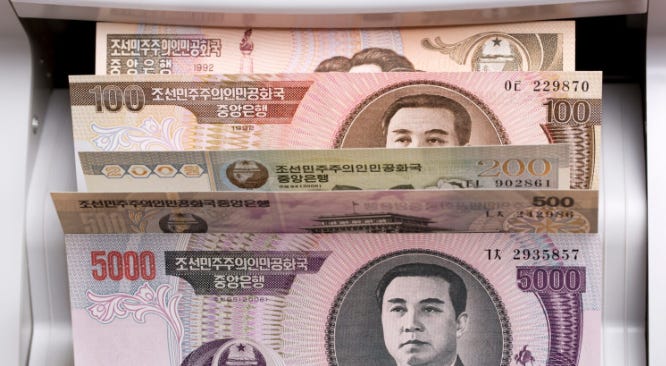
Imagine opening your wallet and finding three different currencies. One is issued by your government, another comes from China, and the third carries the face of an American president.
Now imagine that, despite living in a country that considers the United States its greatest enemy, you might trust the American dollar more than your own country’s money.
Welcome to the unusual world of North Korean currency.
North Korea is famous for its strict political control, isolation, and commitment to Juche, the ideology of self-reliance. Yet behind this carefully constructed image lies a rather surprising economic reality. While the government issues its own currency, the North Korean won, foreign currencies have become an important part of the country’s economy.
And nowhere is the relationship between money and everyday survival more visible than in North Korea’s markets, where the price of something as ordinary as a bag of rice can tell us a great deal about the country’s economic situation.
But before we get to the markets, we need to understand something more fundamental: what makes money valuable in the first place?
Meet the North Korean Won
First things first: North Korea does have its own currency.
The North Korean won (KPW) has been the country’s official currency since 1947. Its banknotes feature national monuments, patriotic imagery, and symbols associated with the state. On paper, the system seems straightforward. North Koreans earn money, purchase goods, and use the won for everyday transactions.
But there is a catch.
Unlike the euro or the US dollar, the North Korean won is not freely convertible on international currency markets. You cannot simply walk into a bank in Amsterdam, London, or Seoul and exchange your euros for North Korean won at a normal market rate. Even more interestingly, the currency’s official exchange rate has often differed dramatically from the rates used in unofficial markets.This creates a peculiar situation: the government can declare what its currency is worth, but that does not necessarily mean people agree.
After all, a banknote is only as useful as what someone is willing to give you in exchange for it.
And, as it turns out, North Koreans have good reasons to be sceptical.
The Day People’s Savings Disappeared
In November 2009, the North Korean government introduced a currency reform that would leave a lasting mark on public trust.
The idea sounded relatively simple. The government replaced its existing banknotes with new ones, removing two zeros in the process. Under the reform, 100 old won became 1 new won. Normally, changing the denomination of a currency does not necessarily make people poorer. If prices, salaries, and savings are adjusted proportionally, the purchasing power of money can remain the same.
But North Korea’s reform came with strict limits on how much old currency people could exchange.
Imagine spending years putting aside a little money whenever possible. Perhaps you sell vegetables, repair bicycles, or trade household goods at a local market. You carefully save your earnings, hoping to provide a better future for your family. Then, almost overnight, the government announces that much of the money you have saved can no longer be exchanged for usable currency.
That was the reality faced by many North Koreans in 2009.
The reform particularly affected people who had accumulated savings through private trading. It was widely interpreted as an attempt to weaken the growing market economy and restore greater state control. Instead, it helped produce the opposite result. If your government can effectively wipe out your savings overnight, why would you trust its currency again?
For many people, foreign currencies offered an alternative.
The Irony of Self-Reliance
Here is where the story becomes particularly interesting.
North Korea has spent decades promoting economic independence and portraying the United States as a hostile power. Yet the American dollar has become an important currency in its domestic economy.The Chinese yuan also plays a significant role, particularly in regions close to the Chinese border, where trade with China has historically shaped local economic activity.
Economists call this phenomenon dollarization, a term used when people increasingly rely on foreign currencies instead of their national currency.
But why would someone in North Korea want dollars or yuan?
The answer is relatively straightforward: stability, usefulness, and trust. Foreign currencies can offer a way to preserve savings when confidence in the domestic currency is low. They are also useful for trade, particularly when goods originate from China and traders need to pay suppliers in yuan.
Imagine a merchant purchasing clothing from a Chinese supplier. The supplier wants payment in yuan, but the merchant earns most of their money in North Korean won. If the won suddenly loses value against the yuan, the merchant needs more won to purchase the same clothing.
That additional cost may eventually be passed on to customers. This is one reason why exchange rates matter even to people who never personally hold foreign currency.
The irony is difficult to ignore: a country whose official ideology celebrates independence has developed a significant reliance on the currencies of other countries.
North Korea may reject American political influence, but its economy has not always rejected American money.
What Is Money Actually Worth?
We often think of money in terms of numbers.
Ten euros. Twenty dollars. A thousand won.
But the number printed on a banknote tells us surprisingly little about what it can actually buy. Economists call this purchasing power: the quantity of goods and services that a particular amount of money can purchase.
Consider a simple example.
Imagine that one kilogram of rice costs 5,000 won today. Next month, the same kilogram costs 10,000 won. Your 10,000 won has not changed, but its purchasing power has. Yesterday, it could buy two kilograms of rice. Today, it buys only one.This is inflation in its most tangible form.
In North Korea, prices can be influenced by several interconnected factors. Supply and demand matter. If a poor harvest reduces the amount of rice available, prices may increase. Exchange rates matter because imported goods become more expensive when the won weakens against foreign currencies. Trade restrictions and border controls can reduce the availability of products, while government policies can influence how goods are distributed and sold.
And then there is geography.
A product available near the Chinese border may be harder or more expensive to obtain elsewhere in North Korea because of transportation costs, restrictions, and differences in local supply. This means that the same amount of money does not necessarily provide the same opportunities to everyone.
The value of money depends not only on the currency itself, but also on where you live, what you need, and what is available.
Economics In Everyday Life
These economic forces become particularly visible in North Korea’s physical markets, commonly known as jangmadang.
These markets expanded during the economic crisis and famine of the 1990s, when the state distribution system could no longer reliably provide enough food and essential goods. People increasingly turned to trading as a way to survive.
Over time, markets became important places for purchasing food, clothing, household products, and other necessities. They also became places where prices could respond to supply, demand, and exchange rates rather than being determined entirely by the government. This makes them especially interesting from an economic perspective.
The price of rice in a North Korean market can reveal far more than how much a household pays for dinner. It may reflect the availability of food, the value of the won, transportation difficulties, or changes in international trade.
Researchers therefore study market prices and exchange rates to better understand economic conditions in a country where reliable official statistics are limited. However, these markets are not completely free. Government regulations, restrictions, and enforcement continue to shape how they operate.
And while markets have provided opportunities for some North Koreans to earn a living, they have also created new inequalities.A successful trader with access to foreign currency may be better equipped to cope with rising prices than a household relying on a fixed state salary.
Which brings us to another important question: who can actually afford to buy what is being sold?
Currency as a Human Rights Issue
Money might sound like a purely economic subject, but its consequences extend far beyond banks and exchange rates.
Consider two North Korean households.
One earns income through trading and has managed to save some money in Chinese yuan. The other depends primarily on wages paid in North Korean won.
Now imagine the won loses a significant amount of its value.
The household holding yuan may be able to exchange its savings for more won, helping protect its ability to purchase essential goods. The household relying on won, however, may find that its income no longer covers the same amount of food, medicine, or other necessities. Both households live under the same government and use the same markets, but their economic circumstances can be dramatically different.
This illustrates how access to foreign currency can become another source of inequality. And in a country where food insecurity remains a serious concern, purchasing power is not simply about economic comfort.
It can influence whether a family can afford nutritious food, necessary medicine, or other basic needs.
It also raises questions about the relationship between economic independence and political control.
When people can earn their own income, they may become less dependent on the state for their livelihoods. Yet when access to markets, foreign currencies, and private trading is restricted, those opportunities can quickly disappear. Money, in other words, can provide a degree of independence, but it can also expose people to new forms of vulnerability.
Can a Government Control Trust?
North Korea’s authorities have repeatedly attempted to bring currency exchange and market activity under tighter state supervision.
But controlling money is not as simple as controlling a border or restricting access to foreign media.A government can issue banknotes, regulate banks, and restrict unauthorised trading. What it cannot easily do is force people to believe that their savings will be safe.
That is what makes North Korea’s currency situation so fascinating.
Money depends on collective confidence. A banknote has value not simply because a government says it does, but because people believe others will accept it in exchange for goods and services. When that confidence weakens, people look for alternatives.
For North Koreans, those alternatives have often included dollars, yuan, and other ways of preserving wealth. Yet even foreign currencies cannot solve every problem. A dollar cannot create food that is unavailable, and a favourable exchange rate is of little use when restrictions prevent goods from reaching local markets.
Ultimately, what matters is not just how much money someone has, but what that money allows them to do.
More Than Just Money
When discussing North Korea, attention often focuses on nuclear weapons, military parades, political leadership, and international tensions.
But sometimes, an ordinary banknote can tell us just as much about the country. The North Korean won reveals the limits of state control. The popularity of foreign currencies exposes contradictions in the ideology of self-reliance. And the changing prices of everyday necessities demonstrate how economic instability can become a question of human rights.
Most importantly, the country’s currency system shows that economic policies are never just about numbers. Behind every exchange rate is someone trying to save money, feed their family, or build a more secure future.
And behind every market price is a much larger story about how goods reach North Korea, who is allowed to sell them, and who can afford to buy them. Those markets deserve a closer look of their own.
Because while currency tells us what money is worth, North Korea’s markets reveal what that money can actually buy, and what people must do to earn it.
You would like to support us ? Consider making a donation to help us keep this work going !